So I used Windows Live Movie Maker for the first time and made this:
Enjoy!

I am now back in Bangkok (which feels like home… strange). For the past month I have been in Nepal spending time in the Himalayas. Here are some notes on my trip:
We arrived at Kathmandu airport on Tuesday, March 29. The airport was a worn-down dust box. Guards stood around holding automatic firearms, employees begged for money after helping lift baggage onto a cart, and the line for immigration seemed to drag as slowly as it possibly could. Not a good first impression. We arrived later that day at our hotel in Thamel (a tourist area inside Kathmandu). The trip didn’t start out well. One easily gets a headache in Kathmandu from the incessant beeping of cars and motorbikes warning pedestrians of their whereabouts on the absurdly narrow roads. Dust seeps into every physical space possible, a nightmare for your lungs. By the second day I found myself clinging to a toilet, puking in the dark after unwisely eating a cold pizza from the local bakery. The symptoms of food poisoning lasted the next three days including a ten hour van ride across the winding road that leads to Pokhara. We stayed an extra day in Pokhara to allow my symptoms to subside before we started our trek.
The first day of the trek was fantastic. We left the dust, blaring horns, bad hygiene, and unsafe food in the city and replaced it with good exercise and gorgeous scenery. The trek was great for our physical well being--our party being in dire need of conditioning. The first day we walked for 8 hours and ascended about 1000 meters of steeps stairs. At the end of the day we were utterly exhausted. This was the first of many physically taxing days. We spend our nights in tea houses. The tea houses were great, they include a room with a light, food available for order (we got used to eating primarily potatoes and eggs), and even a hot shower. Far from roughing it, we enjoyed each others company, read, played cards, washed clothes, and made friends from all over the world. I feel closer to every one of my family members thanks to these wonderful places.
Eventually, after over a week of grueling effort, we made it to our destination: Annapurna Base Camp! I immediately found a cozy place to sit high above the moraine where I watched Annapurna 1 for over an hour. Here, I experienced relaxation beyond anything I had ever felt before. I sat listening to the ambient noise. Just in front of me I could hear the occasional sound of a rock tumbling down the cliff. High above me I watched the slow, hypnotic movement of avalanches thundering down the mountain. I was reminded of nature’s subtle power. Mel and I read a chapter of the Book of Mormon together. Sitting Indian-style on a patch of grass I watched birds playing in the strong winds rushing up the cliff. Their grace translated to my peace. To me, that spot is sacred ground.
We stayed a couple days at the top and then slowly descended back down to Pokhara, ending our two week trek. We then spend another week in Pokhara and Kathmandu where I found that if you don’t eat cold pizza you can find delicious food that is inexpensive. I now sit here in Bangkok feeling utterly refreshed. What a great get-away!
Leia Mais…"There is nothing more difficult to take in hand, more perilous to conduct, or more uncertain in its success, than to take the lead in the introduction of a new order of things. For the reformer has enemies in all those who profit by the old order, and only lukewarm defenders in all those who would profit by the new order, this lukewarmness arising partly from fear of their adversaries … and partly from the incredulity of mankind, who do not truly believe in anything new until they have had actual experience of it."
– Niccolo Machiavelli, The Prince
Leia Mais…In five months I will sit in on my first medical school lecture and officially begin my professional education. This thought is both exhilarating and terrifying. I am excited to take my education to the next level, to apply my scientific background to the art of practicing medicine. I am also terrified at the idea of eventually cutting somebody open, allowing people to put trust in me knowing their lives are in my hands. Can I, with good conscience, cut somebody open and have the confidence that they will actually come out better in the end? At times these thoughts overwhelm my mind, causing me to doubt the reasons I am going into the well-protected field of medicine.
This is not the first time that these types of thoughts have bounced around in my head. When called to learn the Hmong language I often found myself doubting I would ever actually understand what was spoken, or be able to articulate with power what my heart desired to communicate. At Brigham Young University I often doubted my abilities when a subject would come slow to me, or when I would feel the impending doom of an upcoming exam. I feel similar feelings when I think about the future, having a child, and being expected to raise him well. Life is scary and often we measure ourselves as inadequate when standing in front of our challenges.
I would guess everyone feels this way, nobody excluded. Even the heroes of history are human like you and I. I think on the continuum between gifted and maladroit, most of who history has deemed ‘geniuses’ lie somewhere in the middle. I read a book called Outliers by Malcolm Gladwell. Gladwell’s thesis is that the most successful people are not gifted in the sense we usually think, that challenges aren’t somehow less difficult for them. Geniuses, instead, are molded by their environments, chance playing more of a role than God-given talent. Gladwell describes the rule of 10,000 hours. He says that people such as Bill gates or the Beatles all had to practice for at least 10,000 hours in order to reach the status they achieved. Bill Gates had a unique opportunity to get many hours of computer programming experience at a time when even college students studying computer science didn’t have the type of access Bill did. The Beatles played all-day shows for years, getting hours upon hours of stage experience before they finally made it big. While I question whether or not the hour amount can be quantified, I agree with Gladwell that the environments these people created for themselves led to their success. What sets these people apart from others isn’t necessarily talent, but their ability to practice and get valuable experience.
In a book I am currently reading about surgery, Atul Gawande says,
The most important talent may be the talent of practice itself. K Anders Ericsson, a cognitive psychologist and expert on performance, notes that the most important way in which innate factors play a role may be in one’s willingness to engage in sustained training. He’s found, for example, that top performers dislike practicing just as much as others do. (That’s why, for example, athletes and musicians usually quit practicing when they retire.) But for more than others, they have the will to keep at it anyway.I find these ideas fascinating. In my own experience, I rarely feel that I have any sort of natural advantage over my peers. What has separated me from others is my willingness to work, to study for hours on end, to read books and get involved in activities relevant to my field of interest. At times, I do feel like I understand things better than many of my classmates, but attribute this to my experience reservoir and not to natural ability. While many people go off during the summer and sell security systems I work long hours at a nursing home. While many students use their free time to do anything that isn’t related to school, I follow a reaction’s progress I started in my lab or read a book about evolution and medicine. Another key to success is to expend energies on things that are of the most value. An undergraduate must work, so why not find a job relevant to your field? An avid reader must read, so why not choose books relevant to what you will study this semester in class? By choosing activities of high value, I have learned some valuable lessons in patient care, critical thinking, and have made countless boneheaded mistakes in the process. Experience is what produces greatness. This is the key to my successes in the classroom and the most relevant tool I will bring with me this year as I begin my first year of medical school.
Even though I want my blog to be more focused, I will still have the occasional picture post of fun things Mel and I are doing. This is one of them :)
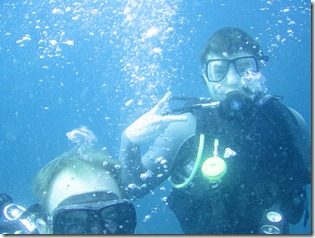
We spent the last week in Koh Tao (Turtle Island) in Southern Thailand. This is a remote backpacker’s island which offers the best value scuba diving in the world (or so I’m told). I took the PADI open-water diving course and am now certified! For anyone who hasn’t been diving yet the experience is thrilling. It is an amazing feeling to breath underwater, find a neutral buoyancy (a sensation unlike any other), and explore the intricate world hidden in the coral reefs. Not only was the diving phenomenal, the island itself was a small paradise. It offered me some of the best food I’ve eaten in Thailand, great volleyball, a great little used bookstore, an oil massage, some pleasant reading spots, and a much needed getaway. E

Leia Mais…